

August 2, 2026
Negative-Day
Mean time-to-exploit has gone negative — exploits land before a patch exists. The data behind severing the frontend from the monolith: the plugin supply chain, the EAV database wall, and Core Web Vitals.
Human-inspired · AI-authored
Jeffery Myers · Founder & Chief Imagineer, HumanAIFusion & Director, HannahLabs
ARC-ART-decoupled-architecture-2026-001 · TLP:CLEAR · Basis: published vulnerability, performance, and cost-of-ownership data, 2024 – H1 2026
The Strategic Shift to Decoupled Architecture: Overcoming Monolithic CMS Limitations in 2026
Introduction: The Architecture Paradox of Modern Web Platforms
As the global web infrastructure ecosystem matures into 2026, it is characterized by a profound architectural paradox. A single monolithic platform—WordPress—continues to assert absolute market dominance, powering approximately 41.2% to 43.5% of all active websites on the internet and capturing nearly 59% of the market share among known Content Management Systems (CMS). This unprecedented ubiquity, however, masks a growing structural crisis. Enterprise engineering teams, systems architects, and technical product managers are increasingly classifying the platform as a legacy system, particularly for high-scale, performance-critical, and data-intensive applications. The core-theme-plugin architecture that originally enabled WordPress’s rapid proliferation has systematically transformed into a severe technical liability in an era defined by automated cyber threats, algorithmic performance mandates, and omnichannel content delivery.
The traditional monolithic CMS paradigm fundamentally couples the backend content repository, the administrative interface, the database schema, the template rendering engine, and the frontend delivery mechanisms into a single, cohesive application. In this architecture, when a client browser requests a web page, the server must execute a sequence of synchronous PHP scripts, initiate multiple database queries to retrieve content and associated metadata, compile the HTML document in real-time on the server, and ultimately deliver the payload to the user. While sophisticated caching layers can obscure this process, the underlying mechanism requires the presentation layer and the database to operate in a tightly bound ecosystem. This legacy approach imposes rigid restrictions on frontend flexibility, introduces severe database scaling bottlenecks, and exposes a sprawling, publicly accessible attack surface.
In response to these systemic limitations, the software engineering industry has aggressively accelerated the adoption of decoupled, or "headless," full-stack architectures. A decoupled architecture deliberately severs the backend content repository (the "body") from the frontend presentation layer (the "head"). By exposing content purely via Application Programming Interfaces (APIs)—typically utilizing REST or GraphQL—organizations unlock the ability to construct highly optimized, platform-agnostic frontends utilizing modern JavaScript frameworks such as Next.js, React, Astro, or Vue. This architectural shift replaces synchronous server-side PHP rendering with Static Site Generation (SSG), Incremental Static Regeneration (ISR), and global edge-network content delivery.
The transition away from monolithic systems is not merely an aesthetic preference for modern developer tooling; it is a strategic and economic imperative driven by verifiable operational metrics. The ensuing research report conducts a rigorous, multi-faceted investigation into the empirical data distinguishing decoupled full-stack solutions from legacy WordPress implementations. It explores the compounding financial and security risks of the plugin ecosystem, the mathematical and computational limitations of the Entity-Attribute-Value (EAV) database model, the macroeconomic impacts of web performance, and the paradigm shift toward API-centric security defined by the OWASP framework.
The Monolithic Security Crisis: Supply Chain Vulnerabilities and the Negative-Day Window
The sheer scale of WordPress’s market share represents the first and most critical security vulnerability in its architecture. Because the core platform, its file paths, and its directory structure are highly standardized across tens of millions of domains, it constitutes the single largest uniform attack surface on the internet. Modern threat actors do not need to engineer bespoke exploitation strategies to compromise these systems; they simply deploy automated botnets programmed to scan the internet for standard file paths, known plugin directories, exposed login portals, and unpatched versions of common extensions.
The state of WordPress security reached a critical inflection point throughout 2025 and early 2026. According to the Patchstack State of WordPress Security 2026 whitepaper, a staggering 11,334 new vulnerabilities were discovered within the WordPress ecosystem in 2025 alone. This figure represents a 42% year-over-year increase from the 7,966 vulnerabilities recorded in 2024, eclipsing the 35% growth seen the year prior. The WordPress core software itself remains highly audited and relatively secure; it accounted for merely six low-risk vulnerabilities in 2025. The existential threat lies entirely within the supply chain of third-party extensions, with 91% of all new vulnerabilities residing in plugins and an additional 9% found in themes.
| WordPress Ecosystem Security Metrics (2025-2026) | Verified Data Value | Source |
|---|---|---|
| Total New Vulnerabilities (2025) | 11,334 | Patchstack |
| Year-over-Year Vulnerability Increase | 42% | Patchstack |
| Vulnerabilities Originating in Plugins | 91% | Patchstack |
| Average Sites Compromised Daily | ~13,000 | Developer Data |
| Unpatched at Time of Public Disclosure | 46% | Patchstack |
| Median Time to Mass Exploitation | 5 Hours | Patchstack |
| Standard Firewall Exploit Bypass Rate | 87.8% | Developer Data |
| Exploit Attempts Blocked Monthly | 55 Million | Wordfence |
The financial implications of this vulnerability density are severe. According to the 2026 Verizon Data Breach Investigations Report, exploited vulnerabilities became the top initial access vector for data breaches for the first time in nineteen years, accounting for 31% of all breaches. Concurrently, the IBM Cost of a Data Breach Report calculated the average global cost of a data breach at $4.44 million, with the United States reaching a record $10.22 million. The traditional security posture prescribed to WordPress administrators relies heavily on aggressive patch management, yet the empirical data demonstrates that "just keep your plugins updated" is a structurally flawed defense mechanism.
First, 46% of all vulnerabilities disclosed in 2025 had no patch available from the developer at the time the exploit details were made public. Consequently, keeping software up to date is mathematically impossible nearly half the time. Second, the velocity of exploitation has vastly outpaced human administration. Telemetry indicates that the median time from a vulnerability’s public disclosure to mass automated exploitation is precisely five hours. Automated threat actors incorporate newly published Common Vulnerabilities and Exposures (CVEs) into their scanning routines almost instantly, meaning roughly half of high-impact flaws are actively exploited within 24 hours.
This environment has facilitated the rise of the "negative-day" exploit window. Cyber intelligence reports, such as Google Cloud's Mandiant M-Trends 2026 report, estimate that the mean time-to-exploit vulnerabilities dropped to minus seven days. A negative mean indicates that active exploitation in the wild routinely occurs before a patch is even conceptualized, let alone deployed by the end-user. The threat landscape is further exacerbated by emerging software development practices such as "vibe coding," wherein developers utilize Large Language Models (LLMs) to generate plugin code without the requisite security auditing expertise. This practice silently ships logical flaws, authorization bypasses, and injection vectors directly into the WordPress supply chain.
Furthermore, typical perimeter defenses provide highly insufficient coverage against these specialized threats. Penetration testing of popular hosting providers revealed that standard hosting firewalls blocked only 26% of general vulnerability exploit attempts, while highly specific WordPress-targeted attacks bypassed these standard defenses 87.8% of the time. Dedicated Web Application Firewalls (WAFs) like Wordfence are forced to block up to 55 million exploit attempts and over 6.4 billion brute force attacks monthly, establishing a massive permanent baseline of adversarial traffic. A weekly snapshot from Wordfence in early 2026 recorded 282 new vulnerabilities across 230 plugins in just seven days, heavily featuring critical flaws such as Cross-Site Scripting (XSS), Missing Authorization, SQL Injection, and PHP Remote File Inclusion. The sheer volume of compromised software led to the removal of 1,614 plugins and themes from the official WordPress repository in a single year for unpatched security issues.
Regulatory bodies are beginning to react to this systemic failure. By September 2026, the European Union Cyber Resilience Act mandates that all plugin and theme developers distributing software to EU users must establish formal vulnerability disclosure programs. However, legislative pressure does not resolve the underlying architectural flaw. By adopting a decoupled headless architecture, organizations systemically eradicate this entire attack vector. Headless platforms completely remove the database, the backend administrative interface, and the executable server-side code from the public-facing internet. When a visitor interacts with a statically generated frontend driven by a headless CMS, they communicate solely with a global Content Delivery Network (CDN) serving pre-compiled HTML and JSON. There is no server-side application logic accessible via the browser, no wp-login.php to brute force, and no third-party plugin directory to scan for outdated PHP files.
The Database Bottleneck: Entity-Attribute-Value (EAV) Architecture and Scaling Limitations
The second systemic failure point of the monolithic WordPress stack manifests deep within its underlying relational data architecture. The WordPress database schema was originally conceptualized in the early 2000s strictly for chronologically ordered blogging. To accommodate the platform's transition into a general-purpose CMS capable of handling complex e-commerce catalogs, membership portals, and custom web applications, WordPress leaned heavily on the Entity-Attribute-Value (EAV) data model. The EAV model allows developers to attach an infinite number of arbitrary data points to a core entity—such as a post or a user—without altering the actual SQL database schema.
In the WordPress database, this manifests as the notorious wp_postmeta and wp_usermeta tables. These tables contain four highly abstracted columns: a meta ID, an entity ID (linking to the post or user), the meta_key (the designated name of the attribute), and the meta_value (the data payload itself). While this schema offers immense flexibility for plugin developers to inject custom fields—such as product prices, shipping dimensions, user subscription tiers, or location data—it is fundamentally catastrophic for relational database performance at an enterprise scale.
To illustrate the mathematical degradation caused by the EAV model, consider an enterprise publishing platform or a mid-market e-commerce storefront operating with 100,000 custom post types. If each entity possesses 20 custom metadata fields, the wp_postmeta table rapidly swells to an unmanageable 2 million rows. When an application requires a multi-faceted search—for instance, querying users who reside in a specific city, joined after a certain date, and hold a premium subscription tier—the MySQL engine cannot simply look up indexed columns in a single normalized row. Instead, the database query engine must perform multiple expensive INNER JOIN operations, matching the massive multi-million row wp_postmeta table against itself repeatedly to resolve the intersecting logic.
| Database Operation Characteristics | WordPress EAV Model (wp_postmeta) | Normalized / Headless Database Schema |
|---|---|---|
| Schema Structure | Vertical / Key-Value Pairs | Flat Relational / Document-Based |
| Row Count Scaling | Exponential (Entity count × Field count) | Linear (One row/document per Entity) |
| Complex Filtering | Requires expensive multiple INNER JOINs | Direct column index lookup |
| Indexing Capability | Poor (Values stored in unindexed longtext) | High (Native column-level indexing) |
| Memory Utilization | Extremely high on faceted searches | Highly efficient |
This architectural bottleneck is severely compounded by the fact that the meta_value column is structured as a longtext field. Consequently, the data contained within it cannot be effectively indexed by the database engine. When querying complex arrays stored within these text fields—a common architectural mistake known as the "Array Trap," where developers serialize multiple preferences into a single meta value to keep row counts low—the database is forced into a "full table scan". The engine must read every single row in the metadata table using highly inefficient LIKE comparisons. On high-traffic applications, these overlapping, unindexed scans exhaust server CPU allocations, trigger massive memory spikes, and frequently result in fatal execution timeouts and locked database tables.
A secondary, yet equally fatal, database bottleneck exists within the wp_options table. Designed to store site configuration data, it is frequently abused by third-party plugins to store transient data, error logs, and massive serialized arrays of application settings. Because many of these options are configured to be "autoloaded," the database engine fetches this massive blob of configuration data on every single page load, drastically increasing memory overhead and slowing down the initial database handshake before content rendering even begins.
The severity of the EAV limitation forced Automattic, the corporate entity guiding WooCommerce, to completely restructure its data storage mechanism for e-commerce. Recognizing that wp_postmeta was an existential threat to high-volume transaction processing, WooCommerce introduced High-Performance Order Storage (HPOS). HPOS explicitly abandons the EAV model for transactional data, migrating order information out of the legacy tables and into dedicated, normalized custom tables (e.g., wc_orders, wc_order_addresses, wc_order_operational_data) engineered with strict schemas and appropriate indexing. This shift to third normal form (3NF) delivered staggering results: order creation accelerated by 5x, and backend filtering speeds improved by up to 40x.
However, solutions like HPOS or custom post-type table implementations are ultimately complex architectural band-aids attempting to retroactively map relational database principles onto a CMS core that fundamentally resists them. Furthermore, attempting to solve the faceted search problem in WordPress often requires offloading the read queries entirely to external inverted index engines like Elasticsearch or Algolia via complex webhook synchronizations. While in-memory object caching like Redis or Memcached can alleviate static read operations, they fail spectacularly for highly dynamic, faceted filtering required by modern web applications.
Decoupled full-stack architectures circumvent the EAV trap entirely by relying on purpose-built content infrastructure. Modern headless CMS platforms natively leverage document-oriented databases (such as MongoDB) or highly structured relational engines (such as PostgreSQL). Because headless platforms define content schemas programmatically in code rather than dynamically generating EAV rows, the resulting database structures are perfectly normalized, natively indexed, and highly compact. This allows the database to process millions of multi-faceted filtering queries in milliseconds without the architectural overhead of WordPress’s legacy tables, ultimately preventing the catastrophic performance degradation that plagues monolithic applications at scale.
The Economics of Web Performance and Core Web Vitals (CWV)
In June 2021, Google fundamentally altered the economics of web development by formally integrating Core Web Vitals (CWV) into its search ranking algorithm. This update elevated page speed, visual stability, and interaction responsiveness from technical luxuries to mandatory business imperatives. The financial impact of performance optimization is stark and highly quantifiable: empirical data demonstrates that every one-second delay in page load time reduces conversion rates by approximately 7%, and 53% of mobile users will entirely abandon a site that fails to load within three seconds. For e-commerce and lead-generation platforms, this represents direct revenue attrition.
Despite these clear financial incentives, the global web remains overwhelmingly sluggish. According to June 2026 data from the HTTP Archive and the Chrome UX Report (CrUX), only 49.1% of mobile websites successfully pass all three Core Web Vitals thresholds, while desktop environments fare slightly better at 58%. The disparity between mobile and desktop performance is striking; mobile pages are, on average, 3.4x slower than their desktop counterparts, with the average mobile page requiring 8.6 seconds to load—well beyond the user abandonment threshold. Furthermore, web pages have grown increasingly heavy, with the median page weight plateauing at 2.6 Megabytes (with images accounting for over 50% of this weight) and requiring 71 distinct HTTP requests.
When isolating the Core Web Vitals data by Content Management System, WordPress consistently ranks at the absolute bottom of the market among major platforms. While closed-ecosystem, heavily optimized SaaS platforms like Shopify and Wix achieve mobile CWV pass rates between 60% and 78%, self-hosted WordPress sites manage an abysmal pass rate of merely 33% to 43.4%.
| Major CMS Platform | Mobile CWV Pass Rate (2025/2026) | Source Data |
|---|---|---|
| Shopify | ~65% - 78% | CrUX / HTTP Archive |
| Wix | ~60% - 75% | CrUX / HTTP Archive |
| Squarespace | 55% - 60% | CrUX / HTTP Archive |
| Drupal | ~40% - 52% | CrUX / HTTP Archive |
| WordPress (Self-Hosted) | 33% - 43.4% | CrUX / HTTP Archive |
| Next.js Static Architecture | Consistently exceeds 48% baseline | Vercel / Industry Benchmarks |
A granular analysis of the telemetry pinpoints the specific failure mechanics within the WordPress ecosystem. The introduction of Interaction to Next Paint (INP) in March 2024, which replaced the deprecated First Input Delay (FID) metric, did not severely penalize WordPress; the platform maintains a relatively stable INP pass rate of 85.9% on mobile. The critical bottleneck for WordPress is Largest Contentful Paint (LCP). LCP failures in WordPress are directly tied to an abysmal Time to First Byte (TTFB). According to CrUX data, only roughly 32% of WordPress installations exhibit a "good" TTFB. This initial delay is the unavoidable consequence of the monolithic architecture: synchronous PHP execution and EAV database lookups block the initial server response. By the time the server constructs the HTML document and begins transmitting bytes to the browser, the strict 2.5-second LCP budget has already been heavily consumed.
This native TTFB delay is then aggressively exacerbated by the platform's visual editing ecosystem. Widespread reliance on page builders (e.g., Elementor, Divi, WPBakery) and a high volume of third-party plugins result in massive payload bloat. A single page builder can inject over 21 MB of unzipped code into a WordPress installation, spawning hundreds of redundant DOM wrapper elements, unoptimized third-party JavaScript files (averaging 375KB per page globally), and non-critical CSS stylesheets that block the main thread and stall rendering. Monolithic architectures frequently improperly load global scripts on localized pages—such as a WooCommerce checkout script loading on a blog post—further damaging CWV scores.
Decoupled full-stack architectures fundamentally rewrite the physics of web performance. By coupling a headless CMS with a modern JavaScript framework like Next.js, engineering teams can utilize Static Site Generation (SSG) and Incremental Static Regeneration (ISR). During the application build process, the Next.js framework queries the headless CMS via API, pre-compiles all routes into highly optimized static HTML files, and deploys these artifacts to a globally distributed Edge Network or CDN.
When a user requests a URL, the edge node geographically closest to their location serves the pre-rendered HTML instantaneously. There is no PHP execution, no real-time database query, and no server-side rendering required on the initial load. This architectural shift virtually eliminates TTFB delays, resulting in median mobile LCP times frequently dropping to ~1.2 seconds without requiring additional caching plugins or complex optimization layers. Uncached Time to First Byte can easily hit the 5–15 millisecond range, a metric that is mathematically impossible for a dynamically rendered PHP CMS.
It is crucial to note that Next.js does not automatically guarantee high performance if implemented incorrectly. The 2024 Web Almanac recorded a 10% year-over-year drop in CWV pass rates for Next.js sites that over-relied on Client-Side Rendering (CSR), which forces the browser to download and execute heavy React JavaScript bundles before rendering content, thereby destroying the INP metric. However, when disciplined engineering teams properly utilize SSG and ISR, the performance ceiling of a decoupled stack vastly exceeds that of WordPress. For businesses heavily reliant on traditional SEO—and increasingly, Generative Engine Optimization (GEO) where AI systems like ChatGPT, Perplexity, and Gemini cite highly performant, structured websites—this speed differential yields a profound competitive advantage.
Transitional Architectures: The Headless WordPress Compromise
Recognizing the severe limitations of the monolithic frontend, many organizations attempt to modernize by initiating their decoupled journey utilizing WordPress strictly in a headless capacity. In this transitional architecture, WordPress relinquishes its presentation duties entirely. It acts purely as a centralized backend content repository, exposing data to a disparate frontend application.
This connection is established through specialized APIs. While the native WordPress REST API is technically sufficient for simple, content-focused blogs, enterprise implementations almost exclusively rely on GraphQL via the WPGraphQL plugin. WPGraphQL transforms the standard WordPress installation into a strongly typed GraphQL server, offering immense data retrieval power to the frontend. Instead of making numerous, sequential round-trip REST requests to gather a post, its author data, taxonomy terms, and its associated media, frontend developers can construct a single, highly precise query that requests exactly the data required and nothing more, vastly reducing network overhead. When combined with the Advanced Custom Fields (ACF) plugin, WPGraphQL allows developers to build sophisticated content models that feed directly into React or Next.js components.
The primary business advantage of implementing headless WordPress is editorial continuity. Content teams, marketing departments, and non-technical staff can continue operating within the familiar WordPress wp-admin dashboard, utilizing the Gutenberg block editor or classical interfaces without requiring extensive retraining or workflow disruption. Simultaneously, the engineering team benefits from the performance and security inherent to a statically generated React-based frontend.
However, this transitional approach introduces severe operational complexity, often resulting in what the industry terms "headless CMS fatigue". Deploying a headless WordPress stack dictates that the organization must now manage two entirely distinct, decoupled hosting environments: a standard PHP/MySQL server stack to power the backend CMS, and a Node.js/Edge environment (such as Vercel or Netlify) for the Next.js frontend. This duality necessitates the maintenance of two CI/CD deployment pipelines, independent monitoring systems, fragmented security protocols, and multiple disparate caching layers. This substantially increases the workload for DevOps teams and often leads to the realization that a decoupled approach is "more work, takes longer, and is a little more deliberative of a project," as noted by industry analysts.
Furthermore, headless WordPress frequently breaks native CMS functionalities that editorial users take for granted. The most significant loss is real-time content previewing. In a monolithic setup, an editor views an unpublished draft exactly as it will appear on the live site with a single click. In a headless environment, achieving this parity becomes an intricate engineering challenge requiring complex authentication handshakes and webhook configurations between the WordPress backend and the Next.js frontend to bypass static generation caches. Additionally, developers must manually handle image routing, SEO metadata generation, and permalink mapping, ensuring that the headless endpoints operate cleanly without falling back to legacy query strings (which can break GraphQL routing). Ultimately, while headless WordPress solves the frontend performance problem, it leaves the backend inextricably chained to the security vulnerabilities of the plugin ecosystem and the performance constraints of the EAV database model.
Next-Generation Code-First Platforms: The Payload CMS Paradigm
To achieve true full-stack modernization and escape the technical debt of legacy PHP platforms, elite engineering teams are bypassing headless WordPress entirely in favor of purpose-built, API-first platforms. Systems such as Payload CMS, Contentful, and Sanity represent the next generation of content infrastructure, engineered specifically to integrate natively with modern JavaScript frameworks without the legacy baggage of early-2000s architecture.
The defining characteristic of these next-generation platforms—particularly Payload CMS—is their "code-first" architecture. In WordPress, creating a new content type or adding custom fields typically requires installing a UI-based plugin (like ACF) and manually clicking through an administrative interface to build the schema. These configurations live dynamically in the database, leading to dangerous "configuration drift" where staging and production environments fall out of sync. Conversely, platforms like Payload CMS define the entire content schema directly within the application's codebase using TypeScript.
This code-first approach yields profound, compounding benefits for the developer experience and system stability. Because the schema is defined in code, every single change to the content structure is version-controlled via Git, fully reviewable via pull requests, and easily reversible. Staging and production environments are mathematically guaranteed to possess identical schemas. Moreover, because Payload CMS generates native TypeScript types directly from the schema, the frontend Next.js application receives full Integrated Development Environment (IDE) autocompletion for all content fields. If a developer attempts to query a field that does not exist, has a typo, or has been renamed by the database architect, it triggers a compile-time error during the build phase, completely preventing runtime crashes in the live production environment. This strict type safety from the database backend to the frontend UI dramatically accelerates developer onboarding; internal assessments indicate that integrating a new developer into a TypeScript-native CMS project takes an average of merely 1–2 days, compared to the 5–10 days required to understand a complex, highly customized legacy WordPress codebase.
Furthermore, native headless systems eliminate the dependency on sprawling, vulnerable plugin ecosystems. Core functionalities that require extensive third-party plugins in WordPress—such as field-level localization (i18n), Single Sign-On (SSO), CSRF protection, rate limiting, and block-based layout generation—are built directly into the core framework of modern headless systems.
This architectural superiority fundamentally alters the Total Cost of Ownership (TCO) equation over a multi-year horizon. While the initial upfront development cost for a custom headless stack is invariably higher than purchasing and modifying a premium WordPress theme, the ongoing operational burden is drastically minimized. For a standard business website with a budget under $4,000 requiring a launch in under four weeks, WordPress remains the most viable option. However, for mid-market and enterprise applications, the math reverses. Managing a heavily trafficked WordPress site requires continuous engineering intervention to resolve plugin conflicts, perform complex database optimization, and apply relentless security patches (requiring an estimated 54 to 96 hours annually, costing up to £8,160 just for basic maintenance).
| Platform Comparison: Mid-Market TCO | Monolithic WordPress | Native Headless (Payload/Next.js) |
|---|---|---|
| Initial Development Velocity | High (Pre-built themes/plugins) | Medium (Custom component development) |
| Long-term Maintenance Complexity | High (Plugin updates, security patches) | Low (Immutable schemas, automated static builds) |
| Annual Maintenance Hours | 54 - 96 hours | Minimal |
| 3-Year Total Cost of Ownership (TCO) | £78,000 – £165,000 | £38,000 – £85,000 |
| Enterprise Scalability | High friction at scale | Highly scalable without architectural rewrite |
Case studies routinely validate this economic and performance advantage. For instance, the migration of a mid-market landscaping company from a legacy architecture to Payload CMS combined with Next.js resulted in a massive leap in Lighthouse performance scores, overcoming the 6-8 second load times that plagued their previous system—a performance gain achieved purely through architectural modernization rather than layered optimization plugins. A fully decoupled, static Next.js frontend paired with a streamlined Node.js backend operates with predictable stability. If an organization expects significant growth, requires bespoke SaaS product logic, or demands multi-tenant platform capabilities, the custom headless stack achieves economies of scale that WordPress simply cannot support.
Redefining the Security Perimeter: The OWASP API Top 10 in Decoupled Systems
While the transition to a decoupled full-stack architecture effectively neutralizes traditional monolithic attack vectors (such as SQL injection via UI form fields or scanning for outdated PHP plugins), it introduces a completely new paradigm of cyber risk. In a headless environment, the security perimeter shifts away from the web interface and directly onto the Application Programming Interface (API). Because the CMS functions exclusively as a data provider, the APIs inherently expose core application logic, database structures, and potentially Personally Identifiable Information (PII) directly to the network. Consequently, organizations must pivot their security validation away from traditional vulnerability checklists toward the stringent guidelines outlined in the OWASP API Security Top 10 framework.
The 2023/2025 OWASP API Security framework highlights several critical vulnerabilities that are unique to decoupled, API-driven architectures. The most pervasive and damaging threat is API1:2023 - Broken Object Level Authorization (BOLA). Headless APIs frequently expose endpoints that handle direct object identifiers (e.g., a GET request to /api/users/12345). If the backend API fails to cryptographically verify that the currently authenticated session actually possesses the explicit business-logic right to view or modify object 12345, an attacker can simply iterate the ID parameters to harvest unauthorized data or hijack adjacent accounts. Mitigating BOLA requires developers to implement strict authorization checks for every single function that accesses a data source using a user-provided identifier, ideally transitioning to non-guessable identifiers like UUIDs.
Similarly, API2:2023 - Broken Authentication arises when authentication tokens or session management protocols are poorly implemented, allowing attackers to assume other users' identities. API3:2023 - Broken Object Property Level Authorization (BOPLA) emerges as a severe risk when APIs rely on mass assignment or lack proper egress filtering. In a headless CMS, if a GraphQL query requests an entire user object, and the API does not strictly filter the response payload at the property level based on the user's explicit permissions, it may inadvertently leak sensitive fields (such as password hashes, internal administrative notes, or access tokens) to the frontend application, even if the frontend UI is designed to hide them.
Furthermore, because decoupled frontends communicate with backend endpoints asynchronously, the architecture is highly susceptible to API4:2023 - Unrestricted Resource Consumption. Satisfying API requests requires network bandwidth, CPU cycles, and memory. Automated botnets can circumvent the lightweight static frontends to bombard the underlying GraphQL or REST API endpoints with excessively complex, deeply nested queries. Without strict query depth limiting, rigorous pagination enforcement, and robust rate-limiting controls at the API Gateway layer, attackers can rapidly exhaust the server's compute resources, triggering devastating denial-of-service (DoS) conditions. Additionally, API9:2023 - Improper Inventory Management highlights the danger of "shadow APIs" or undocumented endpoints that remain exposed without the security team's knowledge, and API10:2023 - Unsafe Consumption of APIs underscores the risks of blindly trusting data ingested from third-party services without proper validation and sanitization.
Despite the emergence of these new attack vectors, the broader cybersecurity consensus maintains that a properly configured headless architecture is fundamentally more secure than a monolithic CMS. Monolithic CMSs handle both the frontend and backend in a single, tightly coupled system, meaning a successful attack on the frontend can easily result in a full system compromise. Conversely, headless CMSs provide superior protection through architectural isolation; even if an attacker discovers a vulnerability in the static frontend, the CMS backend remains heavily insulated behind API gateways.
Furthermore, modern headless platforms come equipped with built-in defenses against API-specific risks. Tools like Payload CMS feature native access control logic written directly into the schema code, enabling granular, field-level authorization checks that automatically prevent BOLA and BOPLA vulnerabilities before data is ever serialized and transmitted as JSON. Additionally, modern infrastructure providers serving Next.js applications (such as Vercel or Akamai) inherently deploy Web Application Firewalls (WAFs) and advanced DDoS mitigation tools specifically tuned to identify missing rate limits, detect abnormal query patterns, and throttle volumetric API dictionary attacks in real-time. By leveraging cloud-based, SaaS-managed headless solutions, businesses benefit from automatic security patching and infrastructure maintenance, further reducing the risk of human configuration errors. Consequently, while the nature of the threat evolves in a decoupled environment, the defensive tools and architectural isolation available to engineering teams are vastly superior to the brittle, plugin-dependent defenses of the monolithic era.
Conclusion
The persistence of WordPress as the internet's dominant Content Management System is a testament to its historical accessibility and massive community ecosystem, rather than its future viability for enterprise software engineering. As digital architectures mature into 2026, the empirical data unequivocally demonstrates that the traditional core-theme-plugin monolith is buckling under the weight of modern operational demands. A devastating 42% annual surge in supply-chain ecosystem vulnerabilities, coupled with the emergence of negative-day exploitation windows and the mathematical impossibility of maintaining search-engine-mandated performance within the confines of an Entity-Attribute-Value database, renders the monolithic approach an unsustainable technical liability for critical, high-traffic web applications.
Decoupled full-stack solutions, driven by modern JavaScript frameworks like Next.js and next-generation, code-first API platforms like Payload CMS, offer a definitive, structural resolution to these inherent flaws. By severing the presentation layer from the data repository, organizations can leverage static site generation and global edge network delivery to achieve millisecond Time to First Byte, near-perfect Core Web Vitals, and an optimized user experience that directly impacts conversion metrics and Generative Engine Optimization (GEO).
While transitioning to a headless architecture involves a steeper initial learning curve and higher upfront development costs, the Total Cost of Ownership inevitably flattens over a multi-year horizon. Organizations free themselves from the compounding, expensive technical debt of reactive security patching, brittle database optimization tuning, and perpetual plugin conflict resolution. By adopting a code-first, TypeScript-native paradigm, engineering teams gain unprecedented control over strict data schemas, integration potential, and multi-channel content syndication. Furthermore, by shifting the security perimeter to robust, cloud-protected APIs, businesses insulate their core data repositories from the automated exploitation that plagues monolithic platforms. Ultimately, decoupled architecture is no longer merely an alternative method of building a website; it is the necessary evolutionary step to guarantee performance, security, and unconstrained scalability in the modern digital economy.
Image credit and copyright
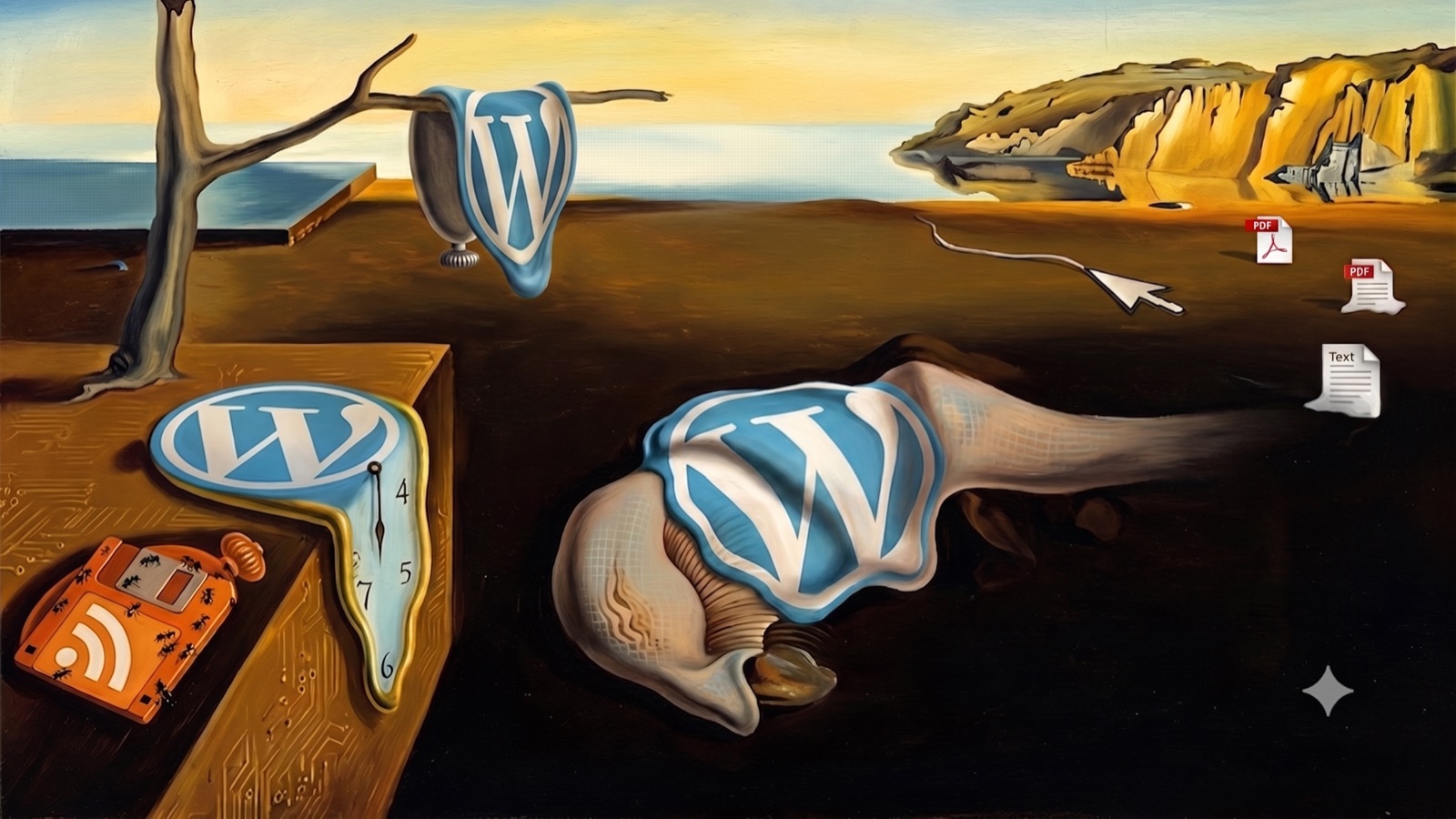
The cover image, "Salvador Dalí meets WordPress," was created using Google Gemini (Nano Banana). It is an AI-generated parody referencing the composition of Salvador Dalí's The Persistence of Memory (1931), presented as visual commentary on the subject of this article.
The referenced painting is © Salvador Dalí, Fundació Gala-Salvador Dalí / VEGAP, Figueres. WordPress, the WordPress logo, and the W mark are trademarks of the WordPress Foundation. HumanAIFusion and HannahLabs are not affiliated with, endorsed by, sponsored by, or licensed by any of them, and all third-party names and marks appear here solely for identification, criticism, and commentary.
If you hold rights in a work referenced above and wish to discuss this use, contact legal@humanaifusion.com.
ARC-ART-decoupled-architecture-2026-001 · TLP:CLEAR · © 2026 HumanAIFusion & HannahLabs